
Easter Island/Rapa Nui Chile 2026
Easter Island/Napa Rui, Chile 2026
The last stop on my 2026 South America Walkabout was Santiago, Chile for one afternoon, then on to Easter Island the next morning for three days. Easter Island, or more properly – Rapa Nui, is the place with hundreds of Moai. These are the huge, carved statues with larger heads that probably everyone has seen at one time or another, but maybe didn’t associate with Easter Island. To help you visualize, Brad Garrett, the big brother on “Everyone Loves Raymond,” was the voice of one of these heads in Ben Stiller’s movie “Night at the Museum.” To the best of my knowledge, Brad is the only actor to ever portray a Moai. As I walked around the Moai I could almost hear “Gum-gum and dum-dum” being uttered. Maybe it was the wind. Or my stomach.
Getting to Easter Island (Rapa Nui) is not easy. It is the most remote inhabited place on Earth. Although, if “most remote” is defined as the furthest from any human contact, then the Verizon Customer Service Helpline may replace Rapa Nui as remote place on Earth. It is 1,200 miles to the next inhabited island and 2,100 miles to Chile. Chile annexed the island in 1887, and currently the only public access to the island is a daily LATAM flight from Santiago. Pre-COVID, there were flights a few days a week to Lima, Peru and Tahiti, but Post-COVID, the Chilean Government blocked all access except thru Santiago in an effort to boost mainland Chile tourism. In addition to limited routing, I had to have a letter of invitation from my Rapa Nui hotel. This was used to file a online request 30 days in advance with the Chilean Government, print the approval letter, survive a diligent in-person screening at the Santiago airport, and promise my firstborn (sorry, Rachel!) before I could even board the flight to Easter Island.
I was met at the airport by the owner of the Hotel Hanau Eepe, Mata, who presented me with a flower lei. Mata spoke very little English and I speak virtually no Spanish and absolutely zero Rapa Nui. Not being able to understand anything the other said, we became fast friends. The hotel had five rooms and looked suspiciously like an ordinary residence, but had a sign on the courtyard entry announcing it was hotel. I never saw anything on the island that resembled what I would have previously called a hotel. Mata’s family occupied rooms 3-5, I was assigned room 1 and room 2 was vacant until my last day. I’m not sure what happens if they have more than two guests. I was invited to every meal, and they cleared off the top shelf of the refrigerator for me. OK, not literally for me, but for anything I wanted to keep cool. This was much more like staying with a favorite aunt and uncle than a hotel.
Now, I’m going to bore you with some facts, but be warned: there will be test. Psych! No test, but I had a guide that took me around the islands to see the Moai for next the two days that disputed basically every bit of information ever published on Easter Island. Andres was a nice guy, and (I think) provided some good information. But often he was more full of caca than the truck that empties the solids out of my septic system every few years.
The island and the natives were called Rapa Nui until a Dutch explorer, Jacob Roggeveen, arrived on Easter Sunday in 1722. Therefore he named it Easter Island. With all those Moai heads mysteriously standing erect all over the island, it would have been so much better if he had arrived on Halloween. Nearly everything you read about Easter Island will be contradicted. Roggeveen estimated 2,000-4,000 inhabitants. The highest population estimate pre-Dutch was 15,000, but the larger theories have the population never more than 4,000.
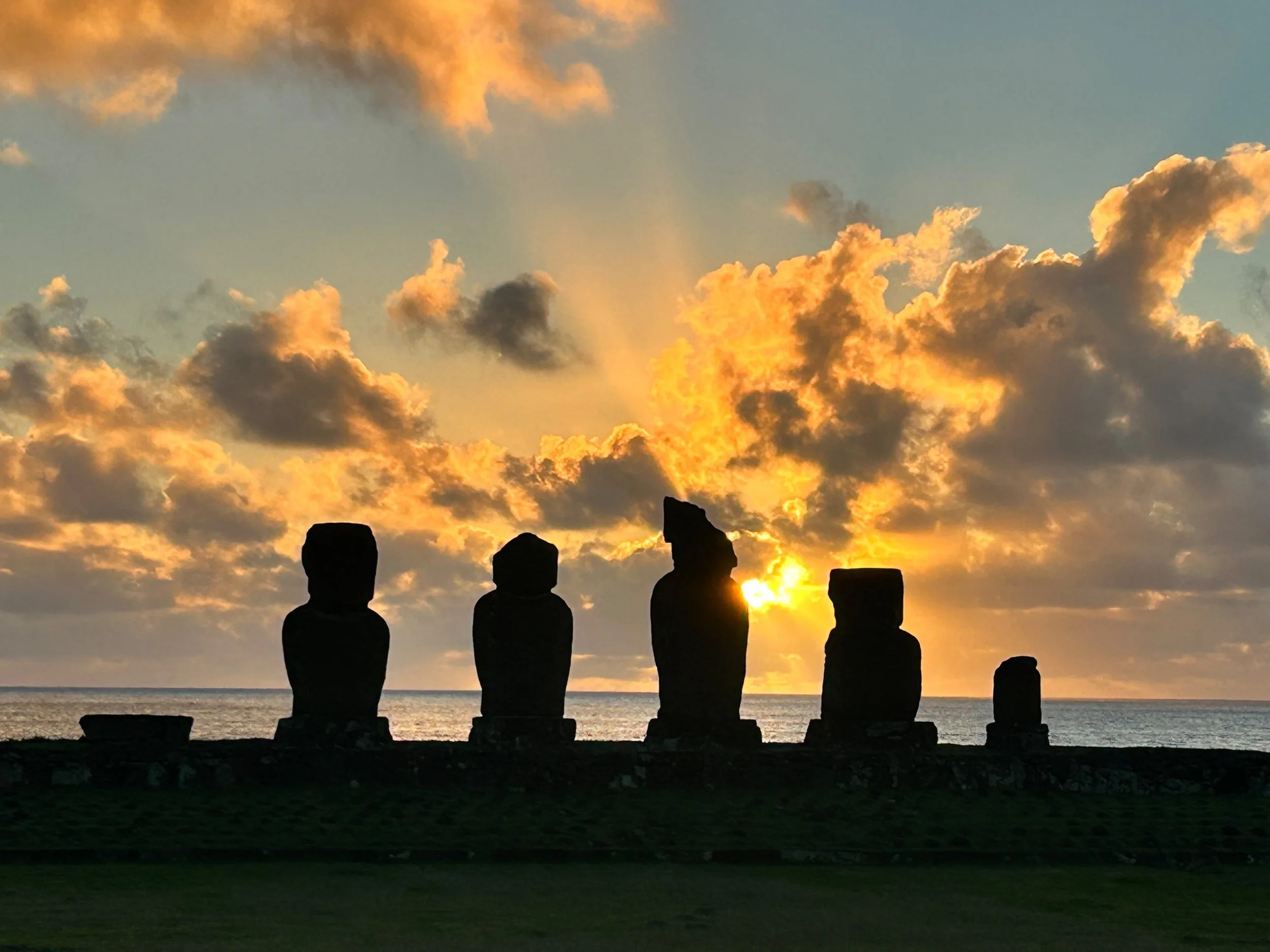
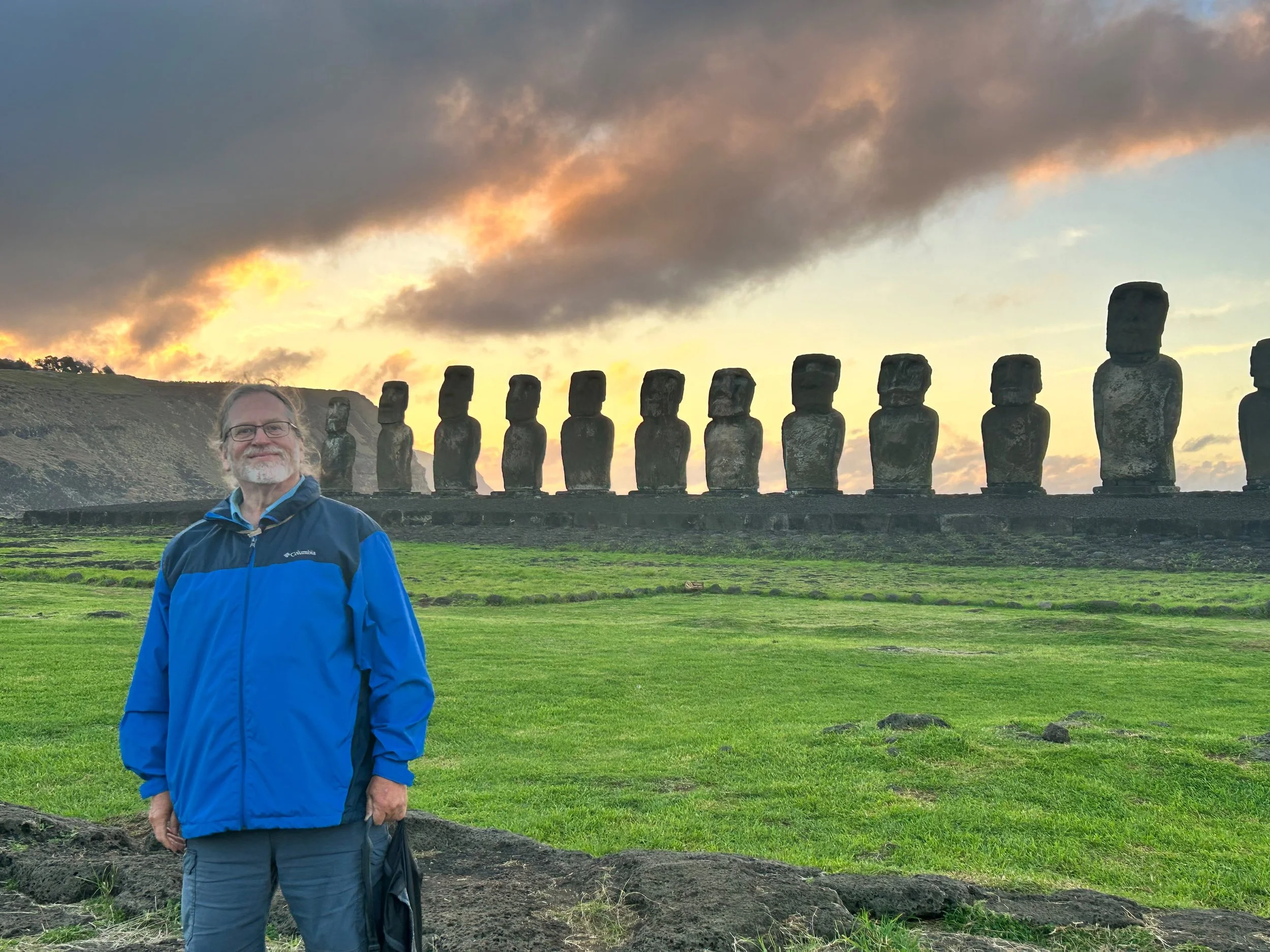
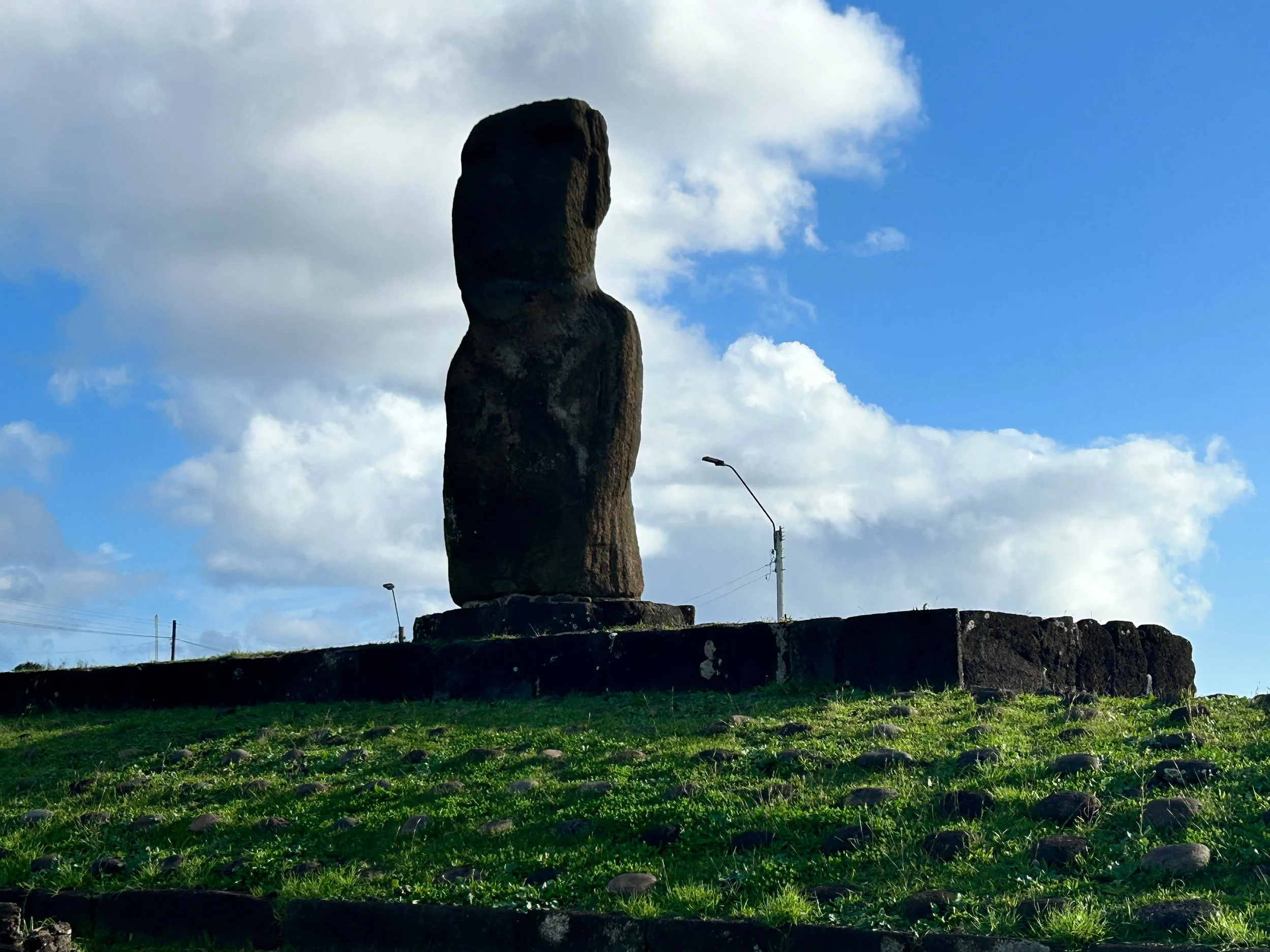
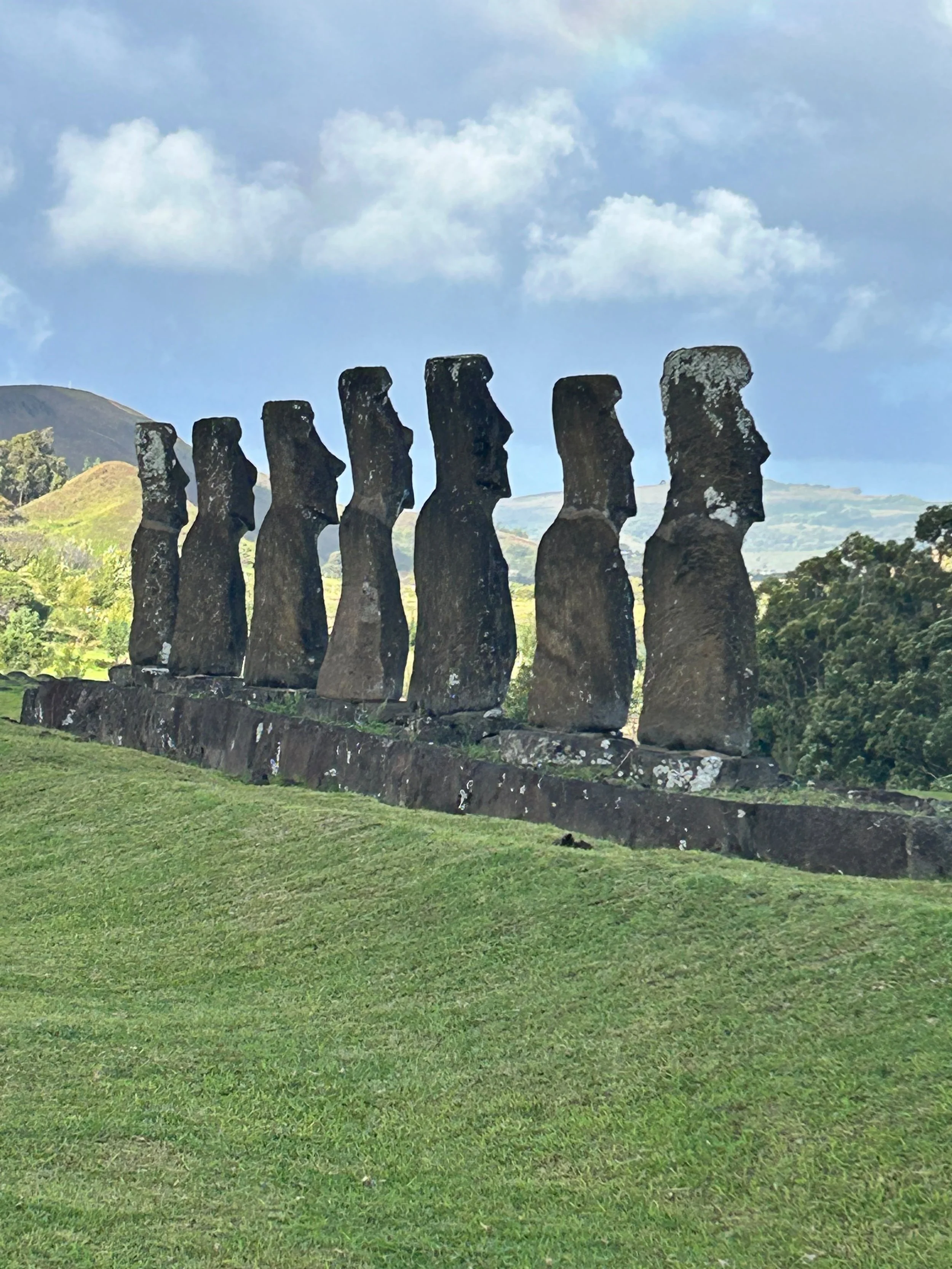
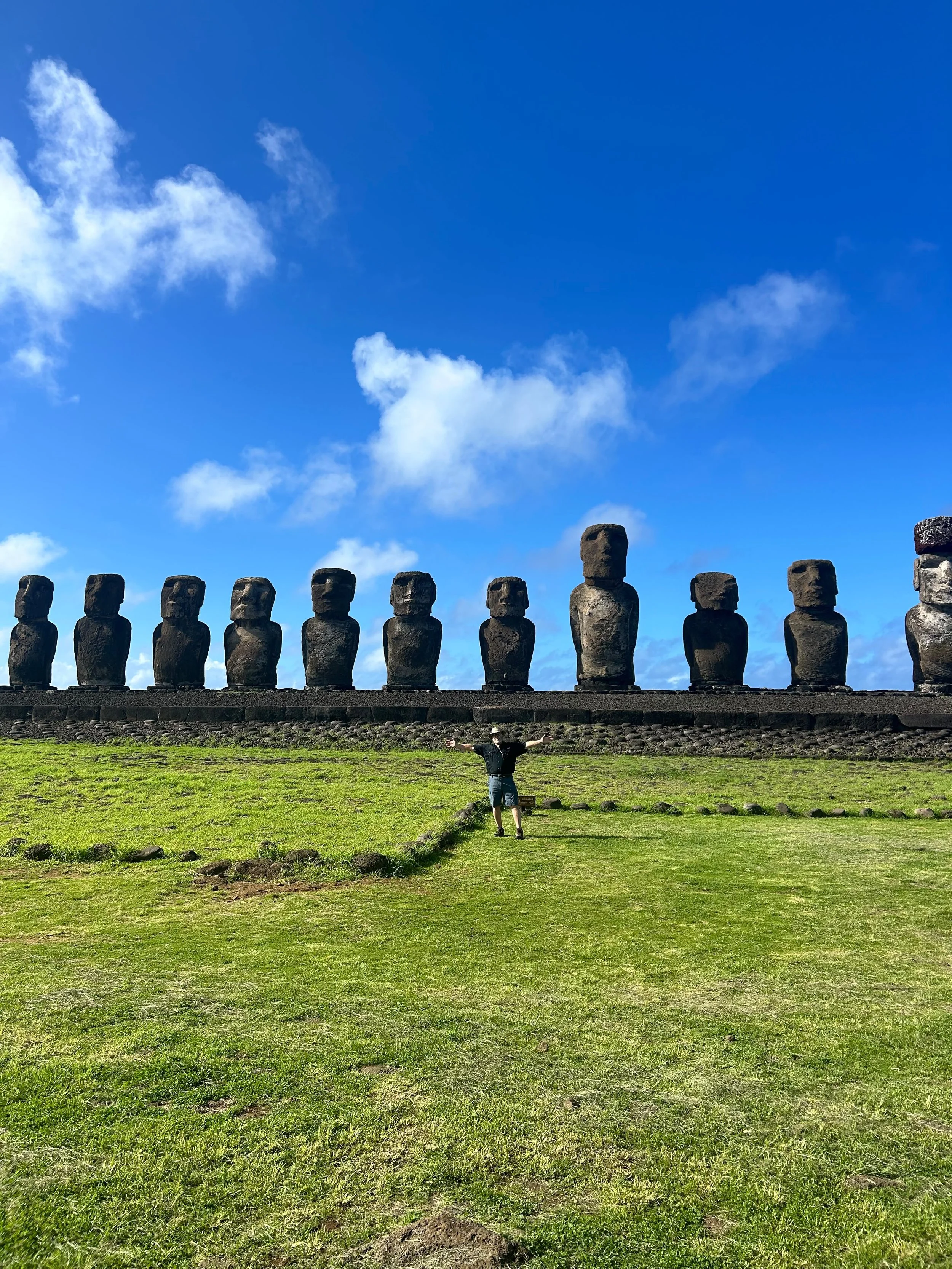
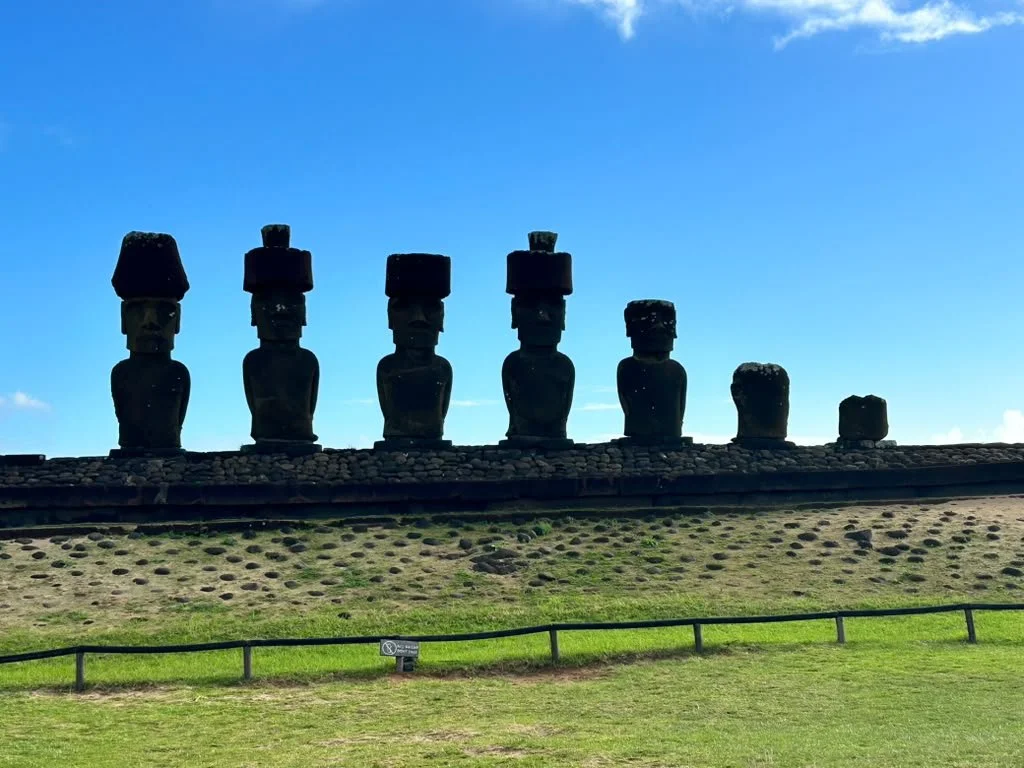
The next issue of dispute is who toppled all the Moai? There were several hundred Moai on platforms, each facing away from the sea and toward the village. The fewest Moai I saw on a platform were a couple of instances of just one Moai and the largest group was 15 at Ahu Tongariki. I got to visit Ahu Tongariki twice: on the first day of my tour, then for sunrise directly over the Moai the third day. The Moai represented important dead leaders and family members and they faced the village to provide blessings and protections. But all of them on the platforms were pulled down and the head was intentionally broke from the body. One theory is that there was severe drought and some of the villages ran out of food and water. They attacked the other villages and they pulled down the Moai to make the attacked-village vulnerable. Another theory is that the Europeans knocked them over, much for a similar reason – to make the villagers feel more vulnerable with their protectors gone.
The reason there is so much mystery around Easter Island was the near extinction of the Rapa Nui. Due to infighting amount the clans, fighting with Europeans, introduction os western diseases such as smallpox, and slavers from Peru capturing or killing nearly all the survivors, the population dropped to 111 Rapa Nui in 1877. And of these, only 36 children were born. The current population of Easter Island is around 7,500, with about half being Rapa Nui descended from these 36 children. This is why the history is so mangled and unknown. There were a lot of symbolic carvings found, but no way to interpret them as language. Therefore nearly all the facts were passed down generation to generation, but with losing so much of the population, so much of the history was lost as well.
Andres, picked me up at 9:30 my first morning on Rapa Nui. He also picked up two Aussies, so only for the second time in my walkabout I had to actually share a tour. Andres was very informative and some of his information was very insightful. Some was humorous. And some was pure bollix. He said he did a lot of research not only on the island, but also viewing artifacts removed from Rapa Nui and displayed in museums around the world. He was making notes and observations and planned to publish a paper or even a book with his conclusions that would debunk many of the theories.
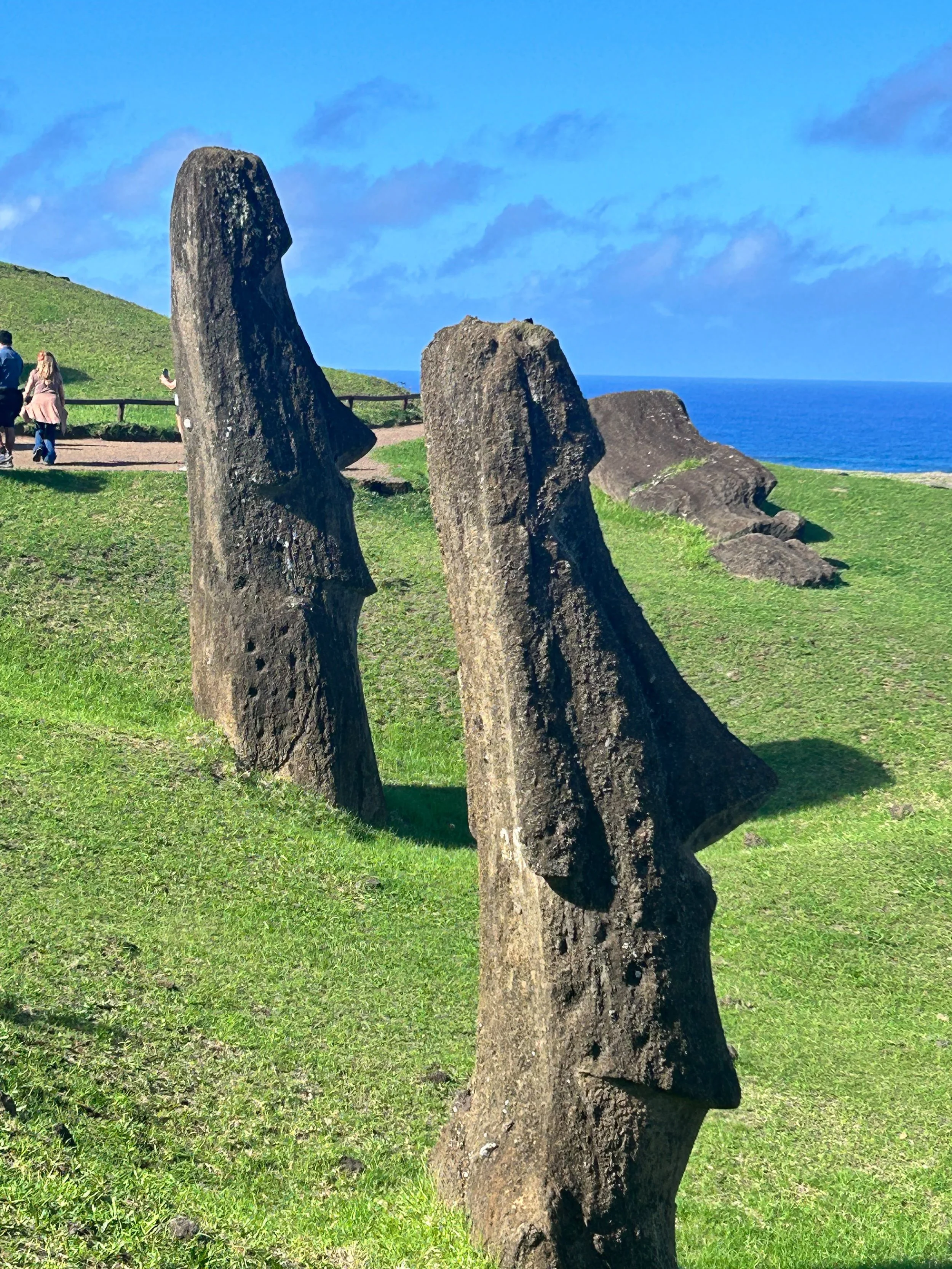
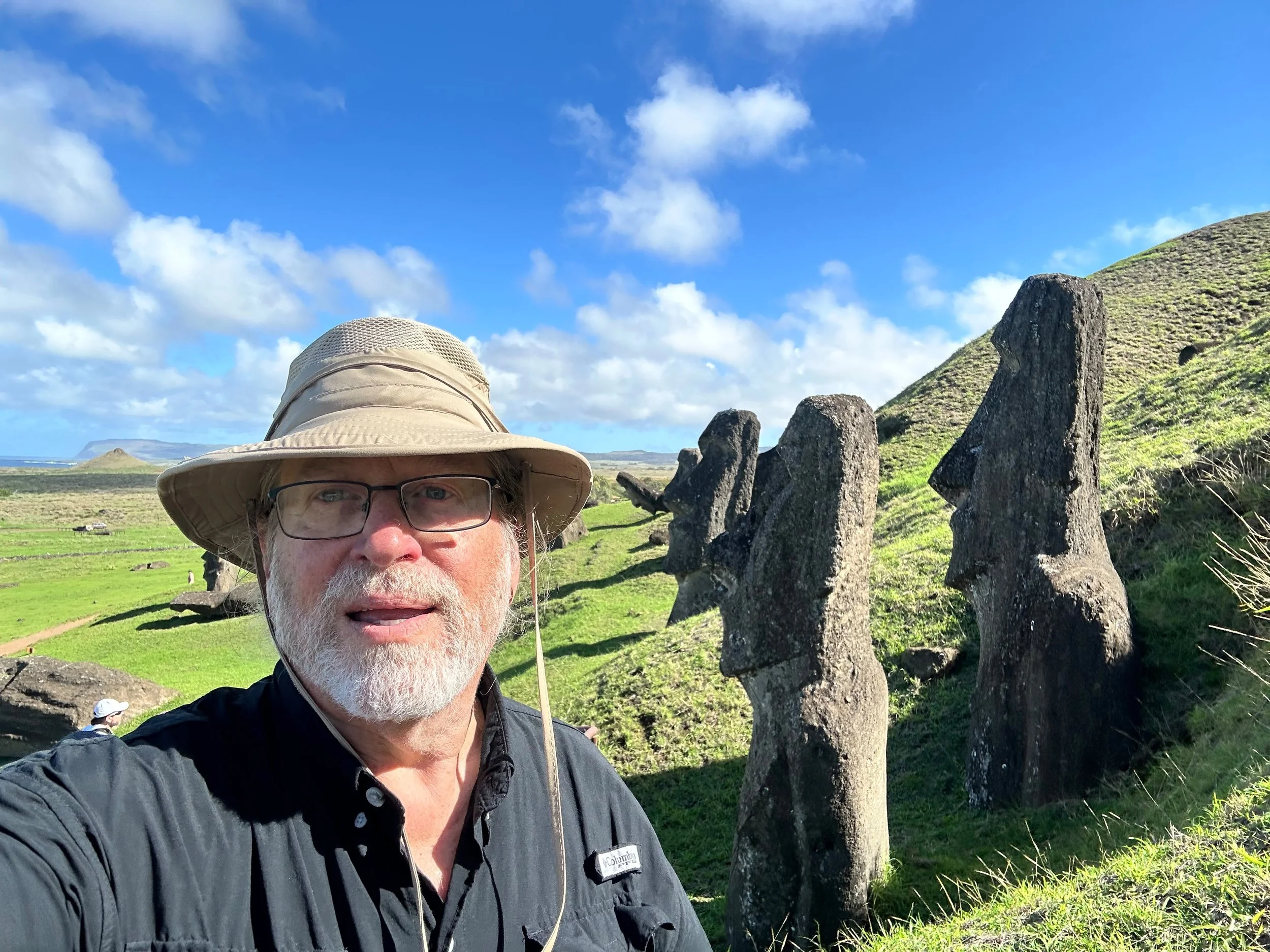
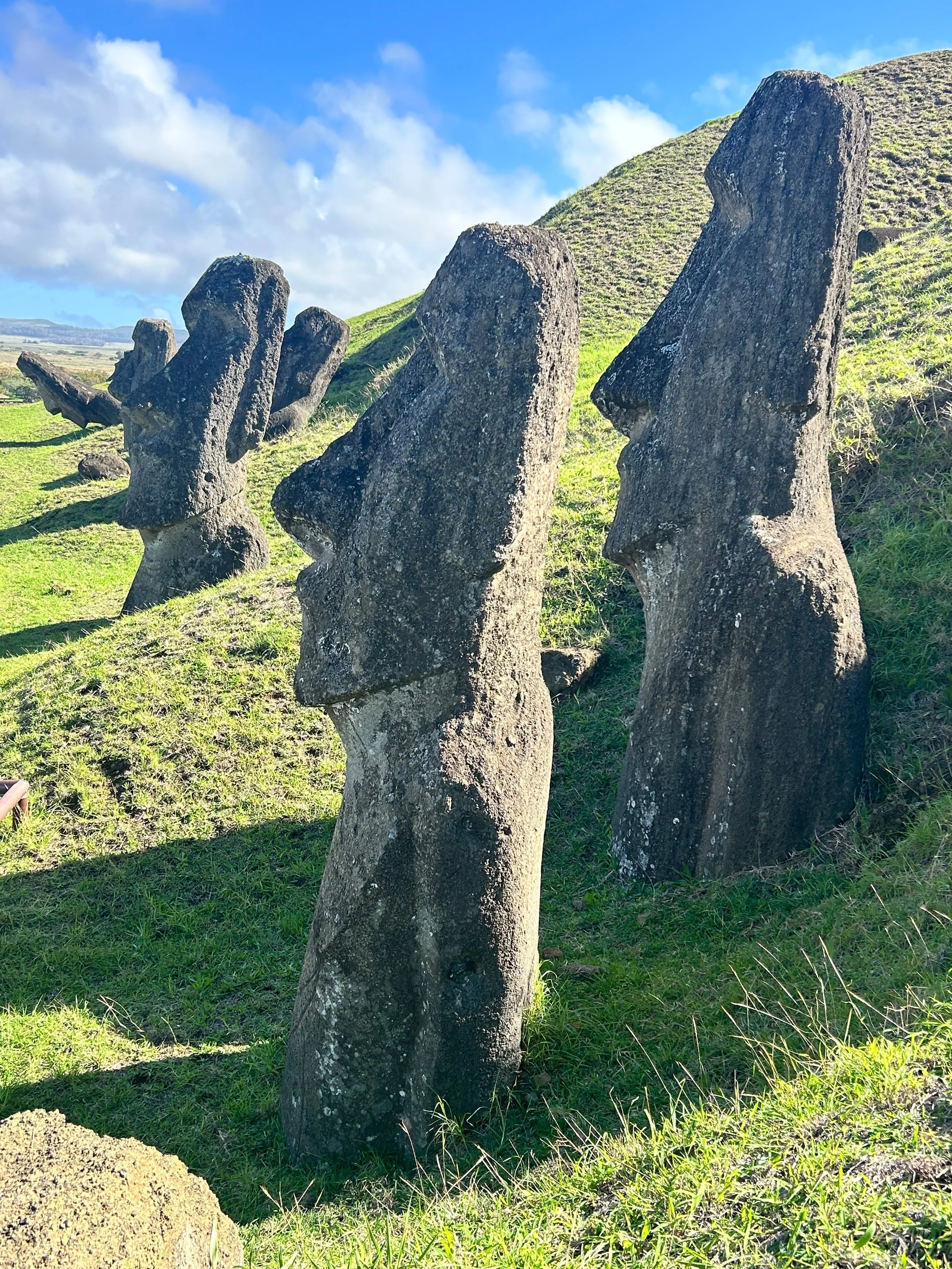
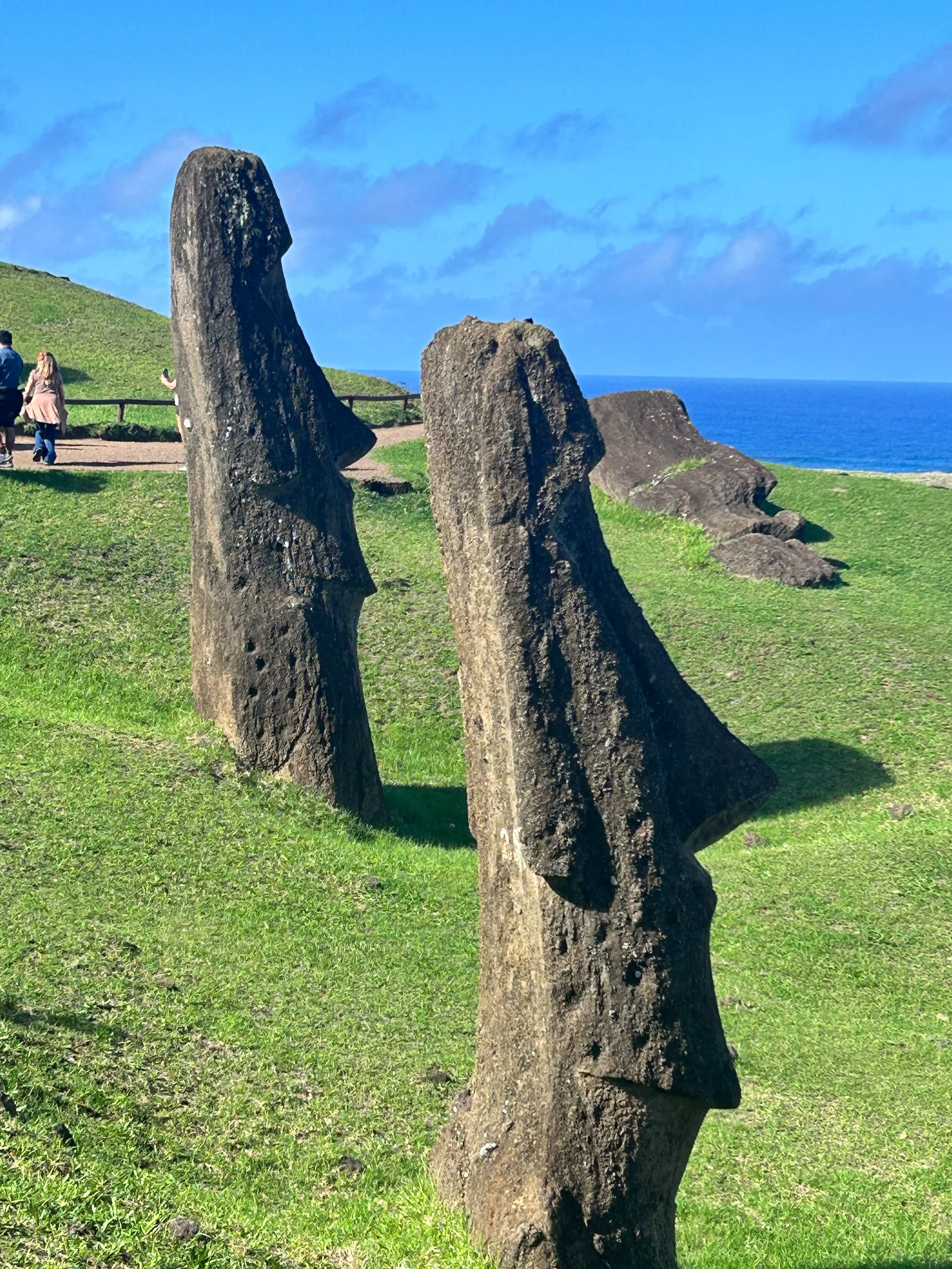
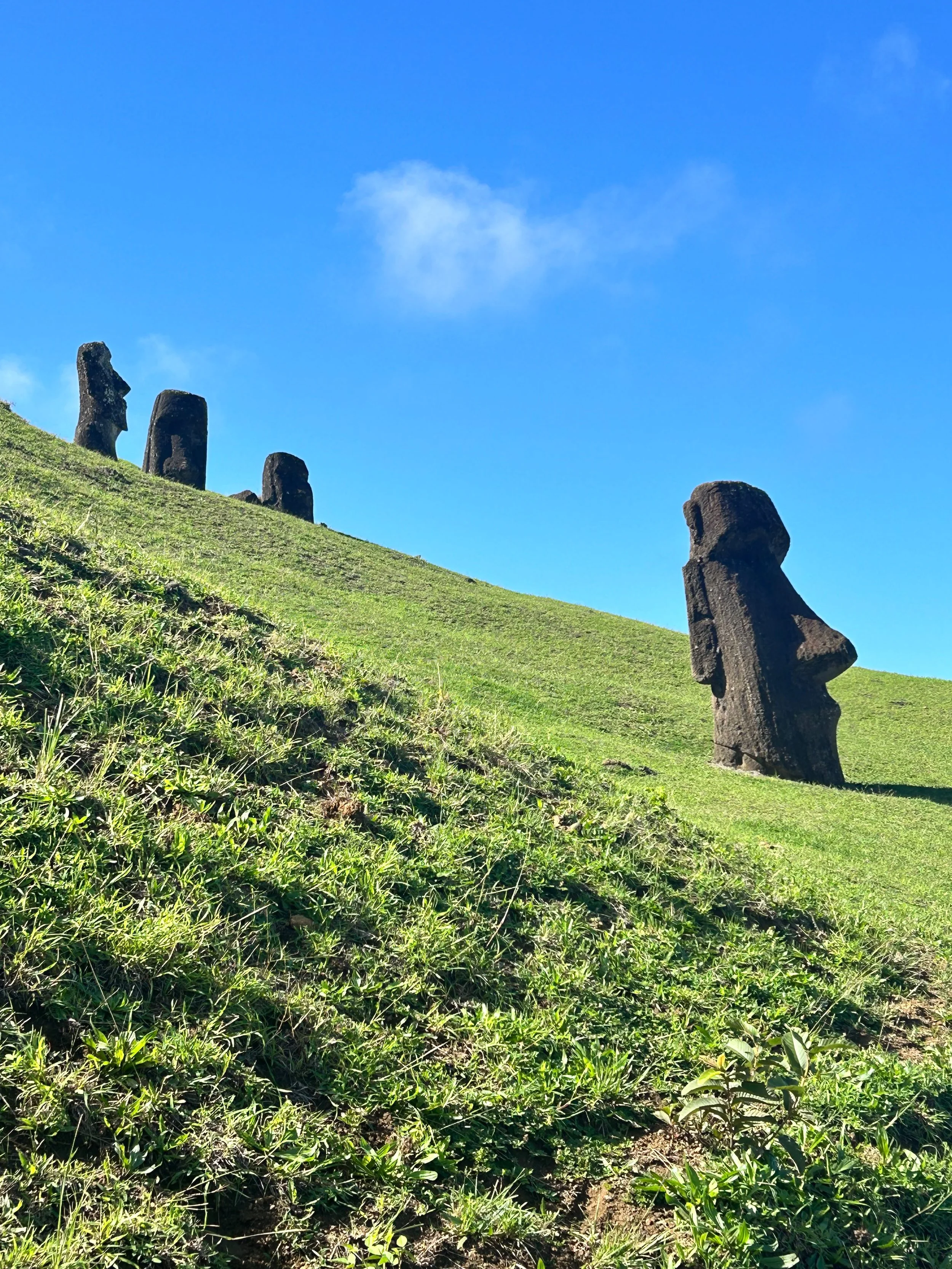
Andres did a great job driving us around the various Moai platforms in a manner that mostly avoided the crowds. There are three distinct ways I saw Moai. The first was the huge platforms with Moai re-stood and, when possible, the head reattached. Most restoration occurred 1950 - 2000. The second was at the Rano Raraku Quarry. This is where you see Moai standing or leaning in green grass all over a hillside. These were the Moai in the process of being sculpted (if lying down face up) or being moved down the mountain with intentions of going to a platform somewhere around the island. Since these Moai were not on platforms and therefore weren’t protecting a village, they were neither toppled nor beheaded. The third was as we drove around the island. I would spot a large rock and Andres would confirm it was a carved Moai, face down. The Moai were moved face down, although how they accomplished moving an average 15 ton carved rock is still highly debated. The largest Moai was 80 tons. These were actively in transit when everything stopped.. So suddenly, dozens and dozens of Moai stopped being moved down the quarry mountain and those being moved around the island were abandoned. Theories of the sudden stoppage include:
1) The arrival of Europeans
2) The reductions of resources – the island was completely deforested about this time, which was the source for boats and canoes, which in turn prevented fishing, a primary food resource.
3) A sudden shift in religious beliefs from the Moai to the Birdman Cult (more on this on day 2 of my tour)
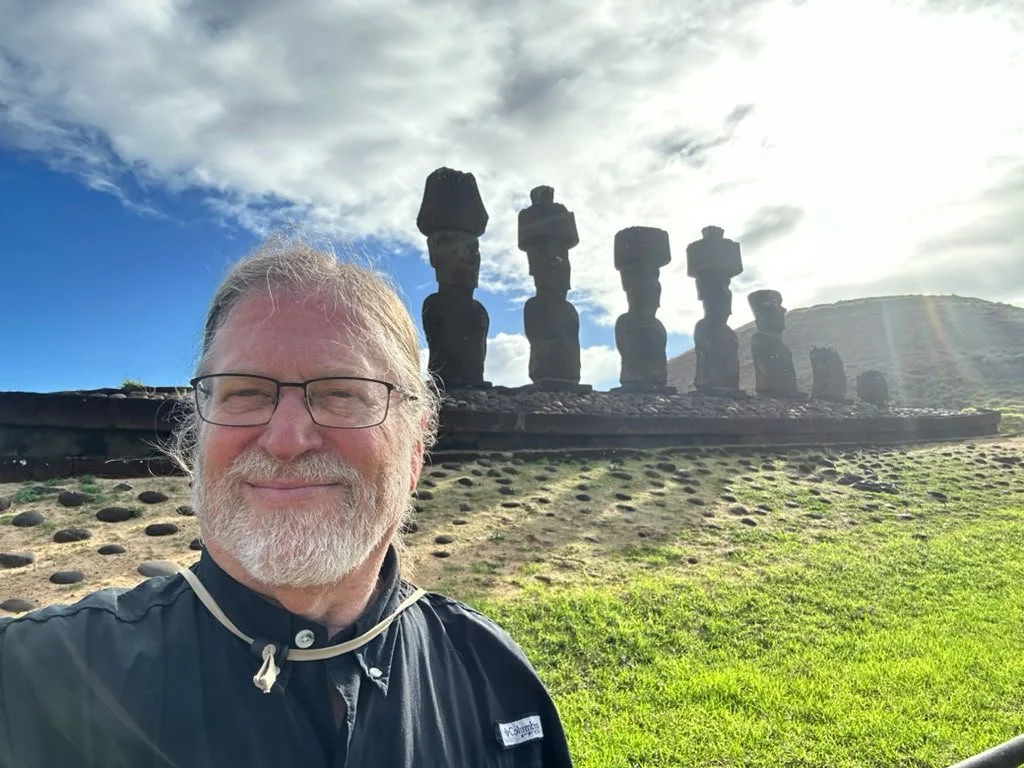
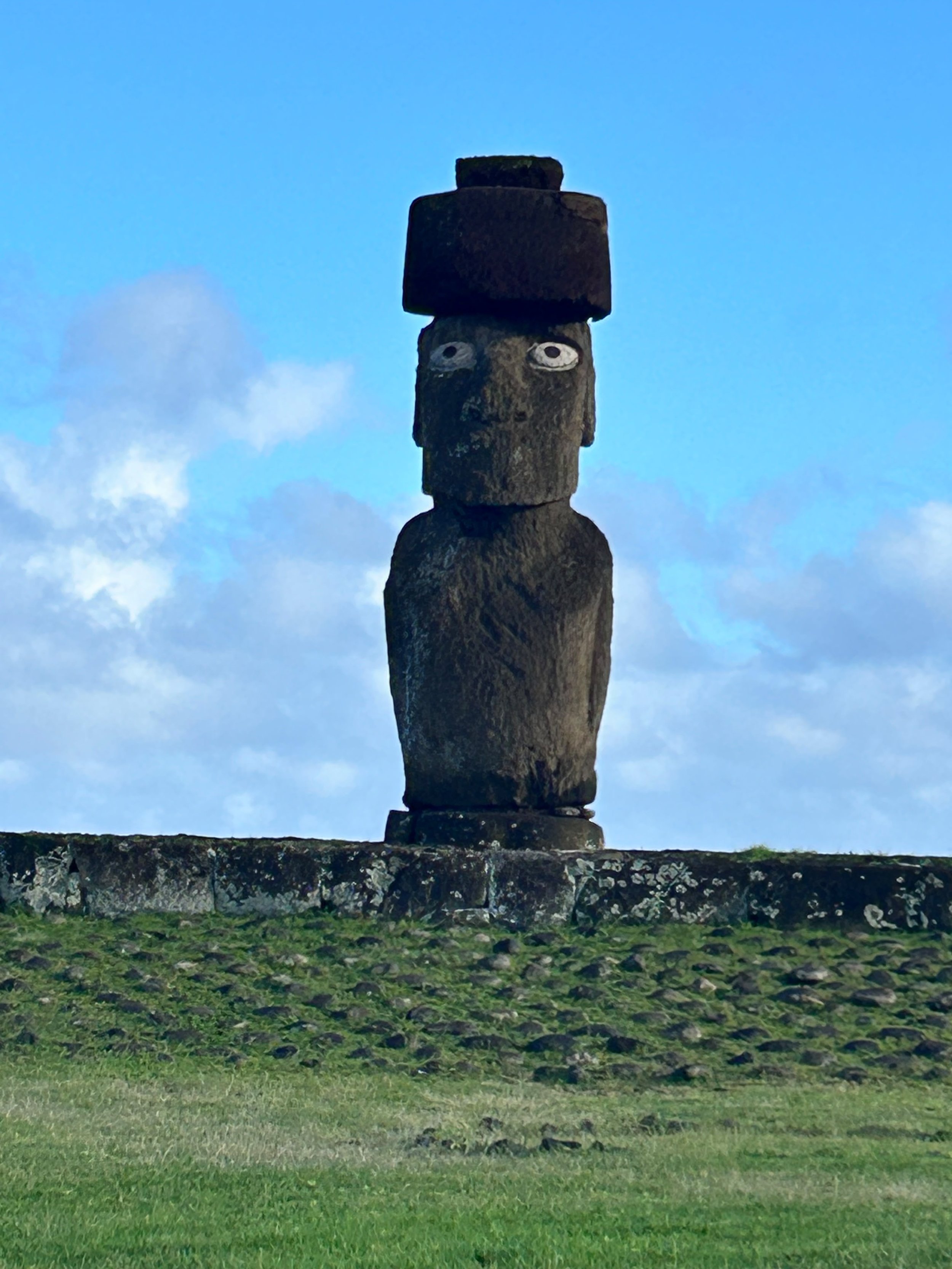
The first Moai platform we visited was Ahu Nau Nau. These were the best preserved because after they were toppled, they were buried in blowing sand. All the Moai are carved from compressed volcanic ash called volcanic tuff. This is a soft sedimentary rock that was easy for the Rapa Nui to sculpt using rock chisels and rock hammers. But, it is very subject to the elements, especially rain and water and that is why the Moai features are often so decayed. While the Moai are one piece carvings, they originally had a cylindrical top piece that was carved from a separate quarry that was red. This top knot represented their long hair tied up.
On day one, Andres explained how the Polynesians explored the ocean and located and settled so many islands. Actually, he lectured. After I ignorantly commented that it took a lot of bravery to set out in a double hull canoe to find an island 1,000 miles from anywhere. I probably stirred the pot even more by pondering how many tried and missed the island dying before they hit Chile or Antarctica. I could now write a thesis after my disciplinary lecture on Polynesian navigation and sailing techniques. I was afraid to ask any more questions and it wasn’t even 10 am the first day. One of the things I did learn during his dissertation was that the Polynesians always carried four animals with them: dogs, pigs, chickens, and rats. Before I could stop myself, I exclaimed “RATS?!” The two Aussies audibly groaned, when Andres launch into a sub-dissertation. He explained that when they landed on an island, their first need was a freshwater source, and the rats could sense water. So they released the rats (he even squatted and pantomimed his hands releasing a rat) and followed them to water. Jumping ahead to day two, the Aussies left to travel home and I was joined on the tour by an American, Jeffrey. At one point, Andres started talking about the navigation and, being the teachers pet, I injected “tell Jeffrey about the animals they brought!” Andres then listed the four animals. When he got to rats, Jeffrey expressed shock and said “For food?” and Andres responded, “Yes, for food.” I waited during his ensuing discussion and there was never a reference to the rats finding water. Maybe he spent his previous evening doing research on his book or paper and was able to debunk the rat/water theory. One interesting fact he did mention that I have also read – the rats were a key component in the deforestation of the island. They would eat the seeds and gnaw the trees. I’m gonna start a theory that rats were the thugs that toppled the Moai.
The second day, we visited additional Moai platforms and the quarry where they cut the cylinder-shaped top knots that were fitted on top of the Moai out of red rock containing iron ore. Then at the end of the day, we visited the ceremonial village where the Birdman Cult was centered. After the Moai, there was an annual competition where each village would select a champion that would climb down the cliffs of the Rano Kau volcano and swim across the shark-infested waters to the islet of Motu Nui. The first to locate an egg of the sooty terns (I think this is where Dave Barry would suggest that “Sooty Terns” would be a great name for a rock band) and return across the water, climb the cliffs, and present it unbroken to his clan chief, then that chief would be crowned the Tangata Manu (Birdman) for the coming year and ruled the island. This process stopped the warfare among the clans and existed from the 16th century until missionaries arrived in the 1860’s and converted the island to Christianity.
The day I flew out, I revisited the 15 Moai at Ahu Tongariki for a cloudy sunrise, then walked about the town until I headed to the airport for my flight back to Santiago, then onward to Houston via Panama City. My new uncle Mata and my new cousins, his grown daughter and teenage son, came into the living room where I was resting before they drove me back to the airport. The son was fluent in English and gave me a necklace with a small Moai. He said it was good luck for my trip back home. The Daughter presented me with an excellent ink drawing of Mata when he was an extra on the movie set of a movie Kevin Costner produced in the 90’s called “Rapa Nui.” Mata was a retired attorney and a recognized poet. He had several books published and I read one that had his poems about life on Rapa Nui in five languages, English being one. Another book in English about indigenous cultures in Venezuela and Chile had an entire chapter about his poems and his efforts to preserve the Rapa Nui culture. He autographed the drawing to me with a saying in Rapa Nui that I haven’t managed to translate. I think it is something like blessings and luck. But it could say “I hope the next occupant of room 1 speaks Spanish.”
After making my way through check-in and security at the airport, chickens met me at the boarding gate. I was going to be pretty upset if any of them were first class while I was in coach. I was use to the chickens by now. Chickens wonder all over the place. I never saw any evidence of heating or air conditioning, so all restaurants and stores were completely open. The chickens mostly left the shops alone because there was no food being dropped. But in the restaurants, they wondered under the diners looking for morsels. If I dropped a crumb, I learned to quickly kick at it, or I might get a foot pecked.
Easter Island/Rapa Nui and Chile were my 95th country in my race to 100. But I have to say that Rapa Nui was different from every other place I have visited in my journeys. In a good way. I enjoyed every minute of it and really felt I was part of Mata’s family. I hope they viewed me as the loveable deaf and dumb cousin that couldn’t communicate with anyone.
Iorana,
Keith
(I saw Iorana frequently around town. Finally Googled and found out it is like Aloha in Hawaii. It means both hello and goodbye.)